
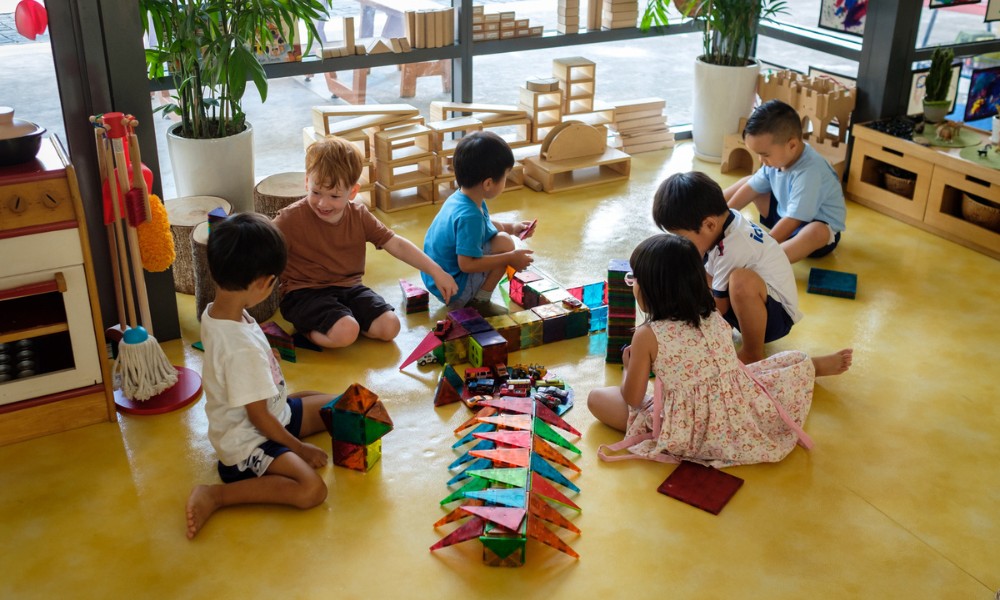
Play gives children a practical way to build language, movement, self-control, and early thinking skills during ordinary routines. Developmental research continues to link active, child-led experiences with stronger social awareness and healthier emotional adjustment. Public health guidance also tracks growth through how children play, learn, speak, behave, and move. That pattern matters because playful activity turns curiosity into daily practice, helping young children strengthen several areas of development at the same time.
Why Play Matters
Many centres designed for children in their early years report seeing richer progress during open-ended experiences than through repeated drills or passive instruction. When children choose, move, pretend, and talk, they test ideas in ways that feel safe and meaningful. Well-planned play based learning activities can support attention, memory, communication, and social ease, while leaving room for exploration, trial, and genuine engagement across the day.
Brain Growth
Early brain development depends heavily on responsive interaction. Play creates that exchange with little effort. A child rolls a car, pauses, then waits for a familiar adult to notice. The response, whether words, facial expression, or shared attention, helps wire circuits linked with language, planning, and emotional security. These brief moments look simple, yet they provide repeated sensory and social input that supports healthy neural organisation.
Language in Motion
Pretend play, storytelling, and sensory activities often prompt more speech than direct teaching. Children label objects, explain actions, and answer peers while staying engaged in the task itself. That kind of exchange strengthens vocabulary and listening together. Repetition also helps sentence patterns settle into memory. As spoken ideas become clearer during play, children gain better control over expression, comprehension, and the ability to communicate in fresh situations.
Social Practice
Shared play gives children room to practice cooperation without formal instruction. One child proposes an idea, another changes the plan, and someone else reacts to disappointment. Such exchanges teach compromise, patience, and flexibility in real-time. Group activity also helps children read tone, notice facial signals, and pause before acting. With regular practice, social play can support empathy and a steadier grasp of how relationships function.
Emotional Control
Children often work through strong feelings by acting out situations before they can explain them clearly. A pretend clinic may soften anxiety about treatment. An imagined family scene can help with separation anxiety or new routines. During those moments, adults can name emotions and model calm language. That support helps children regulate strong emotions, recover after being upset for a while, and return to group experiences with greater emotional balance.
Thinking Skills
Play can link problem-solving to action, which is where young children learn best. A tower tilts, water misses a channel, or a puzzle piece fails to fit. Rather than stopping, many children try another approach. That habit strengthens persistence and flexible reasoning. Hands-on tasks also build an early grasp of cause and effect. Sorting, measuring, matching, and comparing appear naturally, giving basic maths and science ideas a durable foundation.
Movement and Health
Physical play supports growth across both large and small muscle groups. Climbing, crawling, balancing, and running improve coordination, postural control, and body awareness. Fine-motor tasks, such as drawing, threading, cutting, or building, strengthen the hand skills needed for writing as children grow up. Active movement also helps children discharge energy in healthy ways. As motor control becomes smoother, many children show greater confidence and more secure participation in daily routines.
The Adult Role
Play works best when adults observe and join with purpose rather than control. Effective educators prepare inviting spaces, protect unhurried time, and use brief questions that extend thinking. Strong support also depends on predictable relationships and emotional safety. Children need freedom to test ideas, yet they benefit from guidance that matches their stage of development. Such a balance helps playful experiences remain joyful, secure, and developmentally useful.
Everyday Examples
Simple materials often create the richest learning because they leave space for imagination, movement, and conversation.
Simple Setups
Loose parts, dress-up clothes, picture books, water trays, garden beds, and blocks can all support strong development. A cardboard box may become a bus, a cave, or a shop. Clay can strengthen hand muscles while encouraging descriptive language. Outdoor obstacle courses add planning, balance, and body control. These setups work because children stay active, make choices, test ideas, and connect physical experience with emerging thought.
Conclusion
Play-based learning supports child development because it links enjoyment with measurable growth across several systems at once. Through playful experiences, children strengthen speech, coordination, self-regulation, cooperation, and early reasoning in ways that feel natural to them. Research in child health and development continues to support that broad effect. When adults provide safe, responsive opportunities for exploration, children build foundations for school readiness, emotional well-being, and healthy lifelong learning.









0